Book Excerpts
Preface: The Hammer Upon The Temple
From Seven More Sermons to the Dead
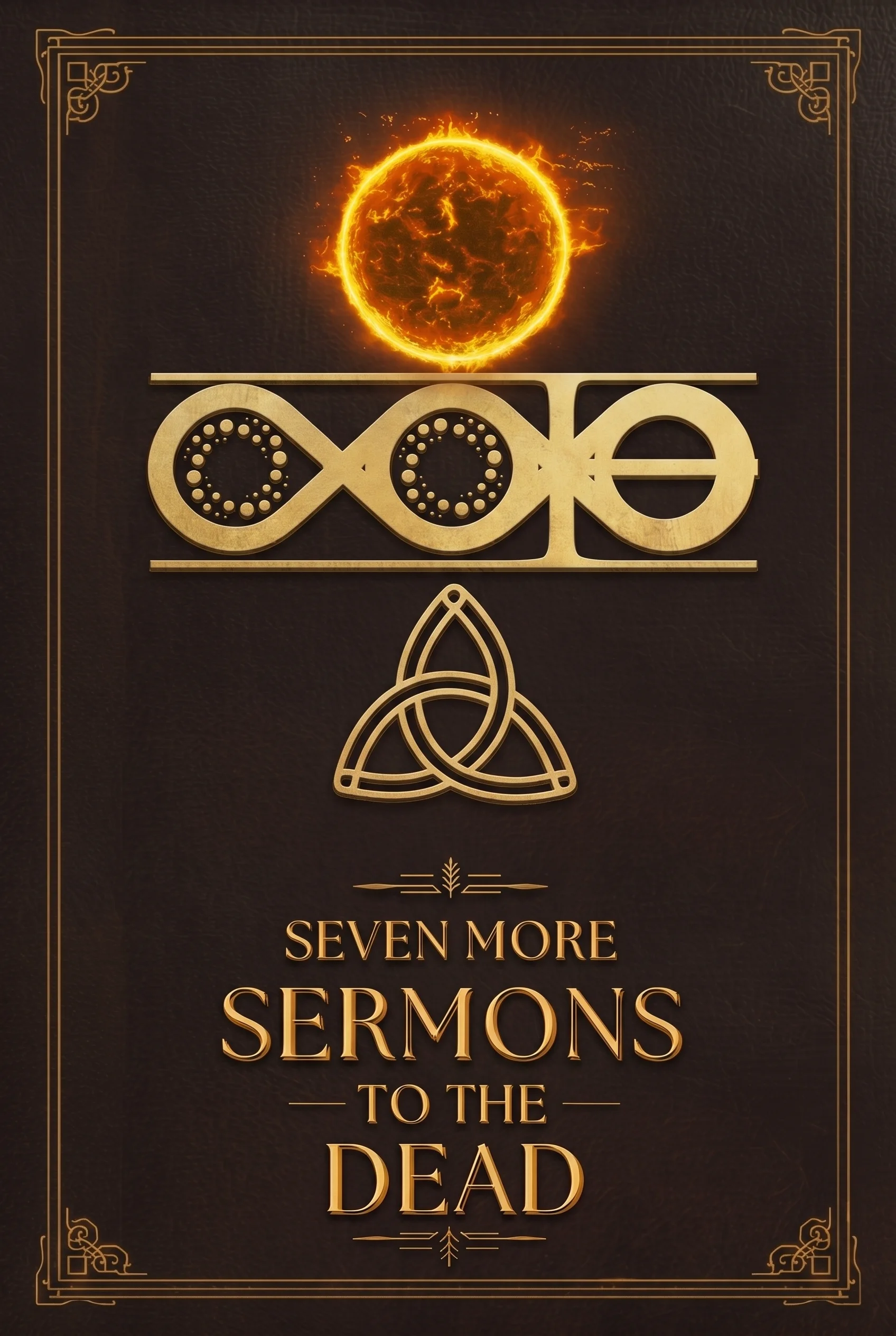
The Seven More Sermons to the Dead, attributed to Chitta Darshana and published in 2026, recasts the strange, unsettling rhythm first intoned by Carl Jung in 1916. That work, titled Septem Sermones ad Mortuos, remained unpublished for nearly a century until it surfaced in a collection of Jung’s esoteric works called The Red Book, published by W.W. Norton in 2009.
Where Jung’s sermons peered into the psyche through the veil of symbolic deities drawn from a Gnostic tradition, this work seizes upon the very roots of the world. It ventures not into dreams of men as Jung did, but into the foundation upon which all dreams rest, and the chains that Man has forged for himself.
Jung, as Basilides, cast a mystical lantern upon the Abraxas. In this work, Chitta Darshana illuminates The Dharma. His words spring neither from the tombs of forgotten gods nor from ivory towers built on sand. There are no celestial revelations. We find only the harmony from which Man arises, the root of the error that ensnares him, and the means of escape.
The Dead
Recall how Jung’s sermons painted a haunting image wherein The Dead, back from Jerusalem, struggled with confusion and doubt. They were drawn to Basilides, like moths to flame. Basilides — as Jung imagined him — unfurled the paradox at the root of all existence: the Pleroma—the clasp of all contradictions, the origin of all things and their utter negation. And then Abraxas — the Effective itself, the All-Creator and All-Devourer. But the Dead found no rest in the end. They drifted away, not redeemed. For what had they truly learned? They stood at the threshold of understanding, the door merely ajar.
Once the thirst for truth is awakened, it does not die peacefully. It gnaws at the bones of certainty. And so, having shed old skins and grown new thorns, the Dead speak again. Drawn to an even fiercer flame, they have journeyed east far beyond Alexandria, beyond the edge of their world.
There, beside the fire, the Herdsman awaits.
After centuries of silent torment, the Dead bring an air of tired desperation, even defiance. When Jung spoke of The Dead, he pointed to restless spirits, the lost and the blind, who walk by the light of borrowed visions. In this work, their portrayal has greater agency, so they may embody all who are caught between truth and delusion.
The Four Temple Walls
The addition of “more” in the title is no sign of a passive sequel. This work is a radical reimagination that strikes against the four temple walls of the Human condition. These are: Determinism, Exceptionalism, Essentialism, and Religiosity.
- Determinism — The belief that existence is governed by fate, prophecy, or law, leaving no room for a genuine choice.
- Exceptionalism — The belief that Man stands apart from and above Nature.
- Essentialism — The belief that names capture something permanent about the named.
- Religiosity — The belief that loyalty to scripture, ritual, and authority is the path to salvation.
The blows are delivered not by grand pronouncement, but by the quiet inevitability of logic, and the very footprints of Man.
This work is meant not only to shatter, but to also clear away, to see what lies beneath. The ground found under the rubble is neither a god nor a name, but the living ground upon which all Becoming rests.
The Genesis of this work
These sermons came about after a period of intense immersion — years devoted to studying philosophies of the East and West, sacred and secular, ancient and modern. I listened to voices separated by centuries, all competing for my attention. And when the voices subsided, I turned to silence — sometimes for hours, sometimes for days — waiting without expectation, listening without purpose. At the end of this period, in October of 2024, these sermons first took shape.
I tried to make sense of them. I cleaned the rough edges as one cleans a weathered artifact—removing obscurities and transcription errors, doing my best not to alter form or voice. Later, I developed the Metaphysic, along with its mathematical and physical analogues, and added a few essays to go along with the sermons and complete this volume
The physical consequences of the Metaphysic are developed in a companion work, Philosophiae Naturalis; the human applications — suffering and its remedies, and the mathematical significance of the two Fields — are covered in more detail in a second volume of essays.
Others have approached this ground from the laboratory, walking from physics toward the questions of meaning. This work walks from the other shore — and the two paths meet at the same water.
Who is Chitta Darśana?
In the Yoga tradition, Citta is the field in which our inner life unfolds. Darśana is a way of seeing the world. Together, Citta Darśana means “a perspective on the field of experience.” It is, in one way or another, a fitting description for us all.
I could not have done justice to the work without recognizing that I was not really the source. This name occurred to me coincidentally, a few months before I put the first sermon to paper. Whether the name is a crutch, a separate intelligence, a forgotten layer of my own mind, or simply the momentum of a thousand voices merging into one – I cannot say. What matters is not where the words came from, but whether they hold weight when tested against your own experience.
Besides, the sermons themselves warn against the idolatry of authorship, and I would be a poor student if I made their author an idol. My task was simply to give them form. That is all. Judge them by their content, not their origin.
On the Archaic Tongue
Like Jung’s Seven Sermons, the Seven More Sermons are wrapped in the garb of Early Modern English. A language borrowed from an earlier age is reminiscent of time-tested wisdom, like the scent of crusty old books or the sacred echo of half-remembered hymns. The charm is real, but the archaic register is not merely an aesthetic indulgence. First, it is a rejection of the pallid assumption that the “new” is always better, and that the “old” is mere history. Nor is the small hill it presents meant to keep you out. It is meant to slow you down. A challenge older than civilization itself — issued and answered across the centuries cannot be consumed; it must be confronted. Read the sermons as poetry: slowly, aloud if need be. Let the rhythm carry what the intellect alone cannot grasp.
It took me a good two years to finish the sermons. I was suspicious of every word, and I found equal relief in the deletions and additions. I suspected every word I wrote down, because spoken out loud, they often did the unexpected. So be careful: to inhabit these words is not to accept them. Do not soften any claims, nor easily dismiss them. Carry them into the world and test them.
For those who persevere, I offer connections with the philosophers who helped me understand what I have seen. These are fragments of insight that may illuminate what the archaic tongue obscures. Don’t think of them as crutches to bear you to safety, but lures to draw you deeper. I pray you will cut through the brush and wrestle with meaning — and in so doing, exceed my understanding.
— From Seven More Sermons to the Dead. Preorder the book.