The story of the Hindu Caste System in India has less to do with its Hinduness and more to do with social evolution, power, racism, economics, opportunism, healing, and reconstruction. In Part I, we looked at the concept of Varṇas and how the evolution of social structure from the Vedic age to Buddhism was interrupted during Islamic rule. In this second part, we will review the introduction of the Systema De Castas (The Caste System) in India, the fight back, and the reconstruction currently underway.
The Caste System In India
In this post, we will trace events from the origin of the Caste System in South America to its introduction in India, the fight against it, and current events.

Systema de Castas
‘Caste’ is the English form of the Iberian word Casta, meaning lineage. In Spanish America in the 17th century, society was racially stratified into Sistema de castas (system of castes). The Spanish Crown required that racial categories be registered at local parishes upon baptism. Initially, there were three ethnic categories – those from Spain (españoles), indigenous American peoples (“Indians” or indios), and the Africans (negros) brought as enslaved people from the Caribbean.

The Systema de castas was a hierarchical ordering of racial groups according to their proportion of Spanish blood. At its most extreme there were more than forty classifications, with español being the most desirable and negro being the least desirable. The occupation and wealth of a person depended on his casta. Spanish officials controlled every aspect of a person’s life – their profession, taxation, legal rights, social rights, dress codes, and friendships. Pictures of Las Castas (like the one above) were distributed to help officials match every person of interest with their casta.
The Castas was officially dismantled by the 1830s, following the wars of independence raging throughout Latin America in the 1810s-1820s.
To summarize the key points of this system:`
- Fine-grained racial profiling & racial classification of people
- Segregation of races based on profession
- Registration of one’s classification at birth
- The Eventual failure of this social experiment by the early 1800s
Introduction of the Caste System in India
After the defeat of the Mughals by the British East India Company, there were several decades of consolidation. There were dozens of battles with chieftains and local kingdoms that the British fought with conscripted Indian soldiers. However, the great Indian freedom struggle (the British called it a mutiny) broke out in 1857, led by Hindu, Sikh, and Muslim soldiers in the British Army. For the small number of British soldiers faced with a mortal challenge, it was a rude awakening.
Immediately after the colonial victory in 1858, the British Crown blamed the near loss of India on the ineptitude of the East India Company and took control of the dominion. A project was undertaken by the British to divide the natives and avoid another united armed struggle. The process of division using religious and regional identities was relatively easy; a thousand years of Islamic rule guaranteed that. However, it wasn’t obvious how the Hindu majority could be divided.
In the British mind, the Portuguese caste system was the most recent in memory. A method to divide a colonized society was needed, and there was a ready model. However, to create legitimacy for such a system in the colonized mind, they needed a religious and historical justification.
The British picked the Manusmriti and the “four classes” as their religious justification because it was the most aligned with their plans, but many British officers did not think this would work. WR Cornish, who supervised census operations in the Madras Presidency in 1871, wrote that,
… regarding the origin of caste we can place no reliance upon the statements made in the Hindu sacred writings. Whether there was ever a period in which the Hindus were composed of four classes is exceedingly doubtful
Similarly, CF Magrath, leader and author of a monograph on the 1871 Bihar census, wrote,
.. the now meaningless division into the four castes alleged to have been made by Manu should be put aside
The British put in a great deal of effort in the 1870s and 1880s to create historical justification for the colonization and find ways to divide the society in more than the four ways mentioned in the Manusmriti. In 1891 Herbert Risley, a British ethnographer and colonial administrator, published The Study of Ethnology in India to outline the race theory of Indian civilization. Risley was a purveyor of scientific racism – the idea that different races evolved differently, with Caucasians (Aryans) at the top. Risley used the ratio of the width of the nose to its height to divide Hindus and Burmese into ‘Aryan’ and ‘Dravidian’ races and different castes. Historian Thomas Trautman writes in his book Aryans in British India that,
… by century's end had become a settled fact, that the constitutive event for Indian civilization, the Big Bang through which it came into being, was the clash between invading, fair-skinned, civilized Sanskrit-speaking Aryans and dark-skinned, barbarous aborigines.
The British associated the newly invented word Caste with the word Jati (of which there were thousands) and not the Varna (of which there were only four). They borrowed some implementation mechanisms from the Portuguese. For instance, Risley commissioned photographs of various Jatis so they could be recognized by local officials based on their clothing, beards, hairstyles, and ornaments. Notably, they could not use skin color because the population was not racially variegated at the local level.
The Aryan Invasion Theory (AIT) was the perfect answer. Proposed by Risley’s contemporary, the German Max Müller, AIT proposed that Sanskrit was imported by fair-skinned Aryans who invaded and ruled the native “Dravidian” population starting in 1500 BCE. According to the AIT, the Aryans were polluted by racial mixing. The Brahmins and Kshatriyas were Aryans, while the Shudras were the defeated dark-skinned Dravidians. The fair-skinned British were repeating history, taking what was rightfully theirs and civilizing the wayward natives once more. Being the fairest of them all, they had the right to rule.
So, with these motivations spurring things along, Risley succeeded in applying his racist theory to the entire population of British India in the 1901 census. British India was vast in size and population and more diverse than Europe. In each region of India, the castes proposed by Risley had to be different for the local people to make any sense of them. In the region of Kochi on the Malabar coast, the enumerated castes included ‘Native Christian’ and ‘Malayali.’ In the state of Hyderabad, the castes included ‘Sheikh’ and ‘Syed,’ which are Muslim honorifics. This arbitrary admixture of religion, varṇa, jati, regional, and language affinity was used to divide the people into 1641 distinct castes. By the 1931 census, this number of castes had grown to 4147.
The Dalit identity

To understand the Dalit identity, one must first understand the idea of Untouchability. The term ‘Untouchables’ has generally been used to describe people ostracized by society. The origin of the phenomenon in the South Asian subcontinent is still under debate.
Dr. B.R. Ambedkar writes that there was no untouchability in the time of Manu and traces its rise to somewhere between the 2nd and 6th centuries CE – untouchability is not mentioned in earlier texts like the Vedas, the Mahabharata, or the Bhagavad Gita. R. S. Sharma theorizes that the institution of untouchability arose when certain tribes with “low material culture” and “uncertain means of livelihood” came to be regarded as impure by a society that despised manual labor and regarded associated impurity with “certain material objects,” such as “meat and bodily fluids.” Simon Charsley, a social anthropologist par excellence who sadly passed away in 2017, has described untouchability as a set of behaviors and not necessarily a group of people.
The term ‘Dalit’ comes from the Sanskrit दलित, which means broken, or scattered, down-trodden. In modern usage, it means the one who has been oppressed but has persevered. The term generally applies to all oppressed classes, including untouchables and certain tribes. The Dalit identity expands beyond Hindus – there are Dalit Christians and Dalit Muslims as well.
Outside India, the term has been used to refer to the Burakumin of Japan, the Baekjeong of Korea, the Ragyabpa of Tibet, the Romani people, and Cagot in Europe, and the Al-Akhdam in Yemen, and the Submerged tenth in England. In general, the groups characterized as untouchable were those whose occupations and habits involved ritually “polluting” activities, such as fishermen, manual scavengers, sweepers, and washermen.


The Great Expansion of the Dalit class
The Dalit identity does not have a history prior to the arrival of the British, although untouchability was practiced prior to their arrival. The true perversion is that the modern communities that derive their lineage from Vyasa and Valmiki have been classified as ‘Dalits’ in a system of caste classification. These were great luminaries of Hinduism – Vyas, the compiler of the Vedas, and Valmiki, the author of the epic Ramayana, were Brahmins (scholars) by the Vedic definition. There are no references to the Vedic sages being considered inferior in any way – that would be heretical. On the contrary, they have always been universally revered by all Hindus, and temples have been dedicated to them.
How did the descendants of Valmiki and Vyaas become Dalits? How did the share of the population of the downtrodden increase to almost a fourth of the total by the time the British left? The most significant political-economic process that was responsible for expanding the phenomenon of untouchability was engineered by the British Colonial government after the 1857 rebellion. After earlier experiments like the Thuggee Act, the British passed the Criminal Tribes Act in 1871 and declared a tenth of the Hindu population (more than 13 million people in 150 communities) as ‘hereditary criminals’ who were ‘passing on’ theft, burglary, house-breaking, robbery, dacoity, and counterfeiting skills from one generation to the next. In this criminal act of the British, the following provisions held:
- Once a community became notified as ‘criminal’, here’s what it meant for its members:
- Every member of the community was forced to register at the local police station and give attendance every day at a specified time.
- Their movements were curtailed. They could not shift residence, travel, or move about without permission
- Breaking the rules resulted in non-bailable punishments like imprisonment
- The local police were authorized to round up any member of the community on suspicion alone
Once these communities were lawfully restricted to specific areas of villages or townships, they lost access to education, livelihoods, and their connection with society. Historians like Meena Radhakrishna see the Criminal Tribes Act as part of a broader attempt at social engineering, which, for example, saw the categorization of castes as being “agricultural” or “martial” or recognizing which groups were loyal to the colonial government and therefore suitable for military recruitment. Susan Abraham notes that many of the tribes characterized as criminals under the Act had earlier rebelled against the British East India Company and participated in the 1857 war of freedom. For example:
- The Bhils had fought against the British on the banks of Narmada and in Khandesh in 1857.
- The Sansis of Punjab fought the British in the First Anglo-Sikh War in 1847
- The Nat, Bajaniya, Koli, Bhamtas, and Vadars acted as messengers during the 1857 war
- The Khonds and Sabors of Odisha fought battles against British taxation in 1846 and 1855.
- The Meenas of Rajasthan fought against the British in Rajasthan in 1824
- The Barwaris were known for their brief rule over Delhi
- The Madas and Murias fought the British in the Bastar rebellion
- The Mundas and Oraons rebelled against the British Tax system.
The Santhals rebelled against the British in 1855


There is no doubt that this expanded oppression was as effectively merged with the notion of untouchability by the early 20th century. In an address delivered as President of the Suppressed Classes Conference, held at Ahmedabad on the 14th and 15th of April 1921, M.K Gandhi notes:
I was hardly yet twelve when this idea had dawned on me. A scavenger named Ukha, an Untouchable, used to attend our house for cleaning latrines. Often I would ask my mother why it was wrong to touch him, why I was forbidden to touch him. If I accidentally touched Ukha, I was asked to perform ablutions, and though I naturally obeyed, it was not without smilingly protesting that untouchability was not sanctioned by religion, that it was impossible that it should be so. I was a very dutiful and obedient child and so far as it was consistent with respect for parents. I often had tussles with them on this matter. I told my mother that she was entirely wrong in considering physical contact with Ukha as sinful.
The influence of the British Class System
By 1917, the Indian National Congress, the largest political party in India, held an annual session where a motion was passed in favor of the ‘Depressed Classes.’ Mr. Bhulabhai Desai remarked during the session that “The existence of this great bane is an insult to the name of Hinduism.” The party leadership, made up mostly of native Indians, felt it appropriate to ask Mrs. Annie Besant, a Britisher. She held horrific ideas about the unprivileged to preside over the session. Mrs. Annie Besant, in an article headed ‘The Uplift of the Depressed Classes in the Indian Review for February 1909, said :
A large class of people, ignorant, degraded, unclean in language and habits, people, who perform many tasks which are necessary for Society, but who are despised and neglected by the very Society to whose needs they minister. In England, this class is called the ‘submerged tenth,’ forming, as it does, one-tenth of the total population. It is ever on the verge of starvation, and the least extra pressure sends it over the edge. It suffers chronically from under-nutrition, and is a prey to the diseases which spring therefrom. It is prolific, like ail creatures in whom the nervous system is of a low type, but its children die off rapidly, ill-nourished, rickety, often malformed. Its better type consists of unskilled labourers, who perform the roughest work, scavengers, sweepers, navvies, casual dock-labourers, costermongers ; and into it, forming its worse type, drift all the wastrels of Society, the drunkards, the loafers, the coarsely dissolute, the tramps, the vagabonds, the clumsily criminal, the ruffians. The first type is, as a rule, honest and industrious; the second ought to be under continued control, and forced to labour sufficiently to earn its bread
Annie Besant’s words are a good indication of how the strict British class system played a part in justifying the the perception of pre-colonial Indian Jatis and the implementation of the caste system in the eyes of the British public. I will leave you with a quote by the celebrated Prime Minister of Great Britain to make my final point that Ms. Besant was no exception.

The Normalization of Caste in India
Before we talk about how the Caste System is being dismantled, we must recognize the genius of the British and their plan:
- In 1835, they set the foundation to convert the minds of the natives through Macaulay’s English Education Act. The act created funds for missionary schools, the translation of European literature into vernacular languages, and the training of English-speaking Indians as teachers. Whatever indigenous educational institutions remained at this time began to decline drastically.
- In 1871, they imposed the Criminal Tribes Act, marginalizing the most independent-minded communities in India – the tribals (10% of the population)
- One generation later, they imposed the census-determined caste system and officially registered the ‘caste designation’ of every man, woman, and child. The education system fully supported the normalization of caste as a “Hindu idea” and the propagation of the Aryan Invasion Theory as justification for this idea.
- Using the caste system, they damaged social cohesion by favoring some groups over others and creating constituencies of support. For instance, they encouraged enrollment of the ‘martial castes’ in the police force and the British army while offering education and government jobs to the Brahmins.
The colonized Indian society in the grip of colonial slavery and a thousand years of Islamic and European-colonial genocides and economic ruin could not find the strength to fight this concerted effort vigorously. Frankly, I think very few realized what was going on.
Caste System Interrupted
Taking responsibility
Do thousands of years of foreign occupation and imposition of the caste system absolve the colonized Hindus? Not entirely. Consider an interaction I had recently. While discussing the caste system with friends, a well-intentioned, highly educated gentleman pointed out an event in the Mahabharata when Sri Krishna (the avatar of Vishnu himself) chose to stay in the house of Vidura, a Shudra, instead of the palaces of Hastinapura. This event was presented as an example of egalitarianism. At first, I thought nothing of this. In a few minutes, I realized the error. I also realized that it had slipped past me the first time. It made me think.
In case you missed it – even in today’s society, there are many Hindus educated in the epics who would call Vidur a Shudra. On the one hand, Vidur was the chief advisor to King Dhritarashtra, the administrator of the Kuru Empire. He was the son of Vyasa, the compiler of the Vedas. On the other hand, the great Vyasa was born out of wedlock to a fisherwoman and her lover. Based on his actions and achievements, it would be reasonable to assume that Vidur was a Brahmin or a Kshatriya. However, based on his birth, he would still be a Shudra, which is why my friend used that label.
By what measurement is any Brahmin-born person more Brahmin compared to Vyaasa or Vidur? Indeed someone with a high intellect and the capacity to teach is a Brahmin. Similarly, any Brahmin-born who prefers to be a farmer or artist should be classified accordingly. Do we debate the son of a lawyer who becomes a politician? Or the son of a software engineer who decides to be a farmer?
We don’t need to defeat British agents to fight the caste system. They have already left and the power of Macaulay’s children is dwindling in their old bastions. The fight is between Varna and Jati, between Dharma and Adharma. Which thought process would win? Will we continue to mix up Jati, Varna, and Caste and remain confused? That question is being answered by actions on the ground in social, legal, political, and academic circles.
Social Reform Movements
The resistance to the nonsense of Caste has evolved since the 19th century. I will cite the so-called ‘lower caste’ reformers in this section, and deliberately omit the mention of so-called ‘higher caste’ reformers like V.D Savarkar, Raja RamMohan Roy, M.K Gandhi, and Swami Dayanand Saraswati.
Mahatma Jyotirao Phule
The first prominent social reformer who fought the caste system was Jyotirao Phule, a contemporary of Risley, in the 19th century. He is credited with introducing the Marathi word Dalit and formed the Satyashodhak Samaj (Society of Truth Seekers) to attain equal rights for people from the oppressed castes. He opened schools for them. However, having been educated in the British system, Jyotirao believed in the Aryan Invasion Theory and saw some European-colonial evangelists as social reformers. The British Crown was also a source of funding for his reformation efforts (his business enterprises supplied material to British infrastructure projects).
Swami Vivekananda

Soon after Phule, Swami Vivekananda continued to fight back. Like Jyotirao, Vivekananda was born into a Shudra family. He became the chief disciple of Ramakrishna Paramhansa, a Hindu monk born into a Brahmin family. Swami Vivekananda famously introduced Hindu darsanas (teachings, practices) of Vedanta and Yoga to the Western world at the Parliament of the World’s Religions in Chicago in 1893. Although the Swami fell into the trap of using the word ‘caste’ instead of ‘varṇa’ in his English writings, he had the right ideas. Under the original varna system, Swami Vivekananda said,
A person’s caste (sic) was defined by the qualities or gunas he or she possessed. The presence of the combination of the three gunas: Sattva, Rajas, and Tamas determined whether a person was a Brahman, a Kshatriya, a Vaishya, or a Shudra. There is clear proof of caste being based on quality in the Bhishma Parwa and in the stories of Ajagarhas and of Uma and Maheshwar
Dr. B. R. Ambedkar, chief architect of the Constitution of India
We have already widely referenced the work of B.R Ambedkar in this text. Dr. Ambedkar was a scholar, researcher, lawyer, and reformer par excellence. He correctly understood that certain sections of society had been co opted into the Caste System and had caused immense harm. However, he was balanced in his approach and recognized that the Caste System was not part of Hinduism, and even recognized that Untouchability was not prevalent in Hindu society until well after the core religious and spiritual texts of Hinduism were established. He viewed the caste system and Untouchability as a social evil.
Dr. Ambedkar also recognized the lies that passed as true scholarship. He rubbished the Aryan Invasion Theory unequivocally and rejected the idea (as pointed out earlier in this article) that Varṇas were based on skin color or racial characteristics.
Ambedkar advocated for inter-caste marriage as the ideal solution to the problem of caste. This position has been formally incorporated into government policy in the present-day BJP government of Narendra Modi. There has never been a bar on inter-caste or inter-religion marriages in India. But today, such marriages are publicly encouraged on a large scale. In 2017, Prime minister Narendra Modi started a scheme to offer 2.5 lakh rupees to inter-caste couples if one of them is a Dalit.
I highly encourage everyone to read, free of charge, the writings of Ambedkar available on the official Government of India website. He was a truly incisive intellect of the highest order.
The Legal fight against the Caste System
The real fillip to this fight only came after independence from British slavery. At that point, laws could be repealed, false histories dismantled, and the damage to social cohesion undone.

The Criminal Tribes Act and Untouchability were outlawed in India, Nepal, and Pakistan after independence in 1952. The Indian Constitution guarantees equal rights to all citizens and prohibits discrimination based on caste, religion, race, sex, or place of birth. It also provides the state power to make special provisions for positive discrimination. Policymakers have instituted affirmative action policies. More than 25% of college placements, government jobs, local government seats, and seats in the Indian parliament (Lok Sabha) are reserved for the Dalit communities. In some educational institutions, as many as 50% of seats are reserved for Dalits and other communities that are behind. Although there is often talk of reverse discrimination, the consensus is that affirmative action has created the right incentives for development.
Today discrimination is not as apparent as it used to be, but attitudes have taken time to change among the older generation and in rural areas. Violence against Dalits is a problem. The violence is sometimes one-sided and has been well documented (Wikipedia). Violence between Dalits and Muslims, the second-largest majority, has also been well documented (recent examples: 1, 2, 3, 4, 5). For historical reasons going back to the Criminal Tribes Act, almost 74% of Christians in India identify as Dalits, although the overall population of Dalits in the country is only 25%. According to Pew Research, Christians are much more likely than the overall Indian population to say there is “widespread caste discrimination in India.”
According to the 2020 NCRB statistics, the crime rate against Dalits at 25%. This number is in line with the percentage share of the community in the Indian population. The reporting rate of crimes has been estimated to have gone up substantially in recent years, and that is good news. However, there are still concerns about the prevalence anti-Dalit crime, especially in rural areas. Due to the slow speed of the Indian justice system (for all litigants), families struggle for years to see cases conclude. Less than 20% of cases get a conviction, and over half are not pursued. The pressure on the families to negotiate a settlement is often remarkably high. This category of violence requires special attention as Dalit victims often live in remote locations and have limited access to legal help and remedy.
The Political Fight against the Caste System
After independence, the word caste became entrenched in the bureaucracy and its official documents, perhaps for lack of a better translation. Compared to 4147 castes in 1931, the 2011 census yielded 4,600,000 castes, and 99% of the castes had fewer than 100 people in a country of 1.4 billion! Almost 70% of Indians now identify themselves as members of marginalized castes. According to the 2011 socio-economic and caste census, the distribution by caste across religions was as follows:

Due to the “democratization” of caste, the system of state patronage that supported caste politics and caste discrimination is fraying at the edges. Voters and politicians realize that caste politics has readied its use-by date. Voting patterns indicate that caste-based voting is waning, while Hindu revivalism is ascendant. The people of India voted across caste lines in the 2014 and 2019 national elections, and the trend grew more robust in the 2021 elections in India’s largest state of Uttar Pradesh. Today, the Prime Minister of India, Narendra Modi, the most powerful leader of India since Nehru, belongs to a marginalized caste. Modi enjoys unprecedented support across caste lines. The President of India, Ram Nath Kovind, is from the Koli community of fishermen, classified as a marginalized caste.

The Academic Fight against the Caste System
Two struts held up Risley’s race theory of Indian civilization. The first idea was the inferiority of the native races of the subcontinent (and the superiority of the Aryan race). The second idea was that Aryans had already conquered the subcontinent millennia ago and were simply returning to regain their birthright.
The end of race superiority theories
The idea of racial superiority died a quiet death after the conclusion of Nazi policies. Racism became universally unacceptable. The allied powers could no longer sustain their own milder versions of such policies after 1945. Consequently, support for such theories in academic circles also died a natural death.
The End of the Aryan Myth
Even though it lacks evidence, the Aryan Invasion Theory (AIT) has been the only theory of Indic origins taught at schools in post-independence India. The reasons are primarily political – a) to encourage fear in the so-called ‘oppressed castes’ and consolidate their vote banks; b) to damage the Hindu right-wing which is accused by the opposition groups to be supported by the ‘upper castes.’
To recap, AIT proposed that:
- Fair-skinned Steppe Pastoralists (Aryans), mostly males carrying the R1A haplogroup, invaded the native “Dravidian” population (who created the Indus Valley Civilization) around 1500 BCE.
- The Aryans also went to Europe with their R1a1 gene, along with farming technology, horses (mentioned in the Vedas), the Sanskrit language (or proto-Sanskrit), and Vedic literature.
- In India, the Aryans were polluted by racial mixing. The Brahmins and Kshatriyas are Aryans, while the Shudras and Dalits are the defeated (and enslaved) dark-skinned Dravidians.
Proponents supported the AIT using two pieces of circumstantial evidence:
- The higher incidence of R1a1 in Northern India compared to Southern India, and its incidence in Europe.
- The strong similarities between the Indo-European languages, such as German, Polish, Sanskrit, Hindi, and so on, suggest a common language ancestor.

When archeologists discovered the Indus Valley Civilization (IVC) sites of Harappa and Mohenjodaro in 1920, they explained them as Dravidian settlements that were destroyed by Aryan invaders. That theory died an embarrassing death over the next 40 years as scientists failed to find any evidence of a war or conflict that would indicate such destruction. George Dales, an archeologist who went on to join the faculty at UC Berkeley, said in 1961:
... we cannot even establish a definite correlation between the end of the Indus civilization and the Aryan invasion. But even if we could, what is the material evidence to substantiate the supposed invasion and massacre? Where are the burned fortresses, the arrowheads, weapons, pieces of armor, the smashed chariots and bodies of the invaders and defenders? Despite extensive excavations at the largest Harappan sites, there is not a single bit of evidence that can be brought forth as unconditional proof of an armed conquest and the destruction on the supposed scale of Aryan invasion
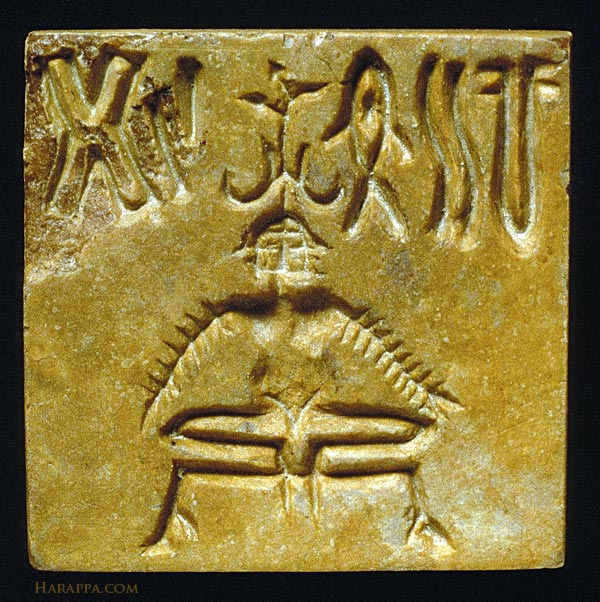
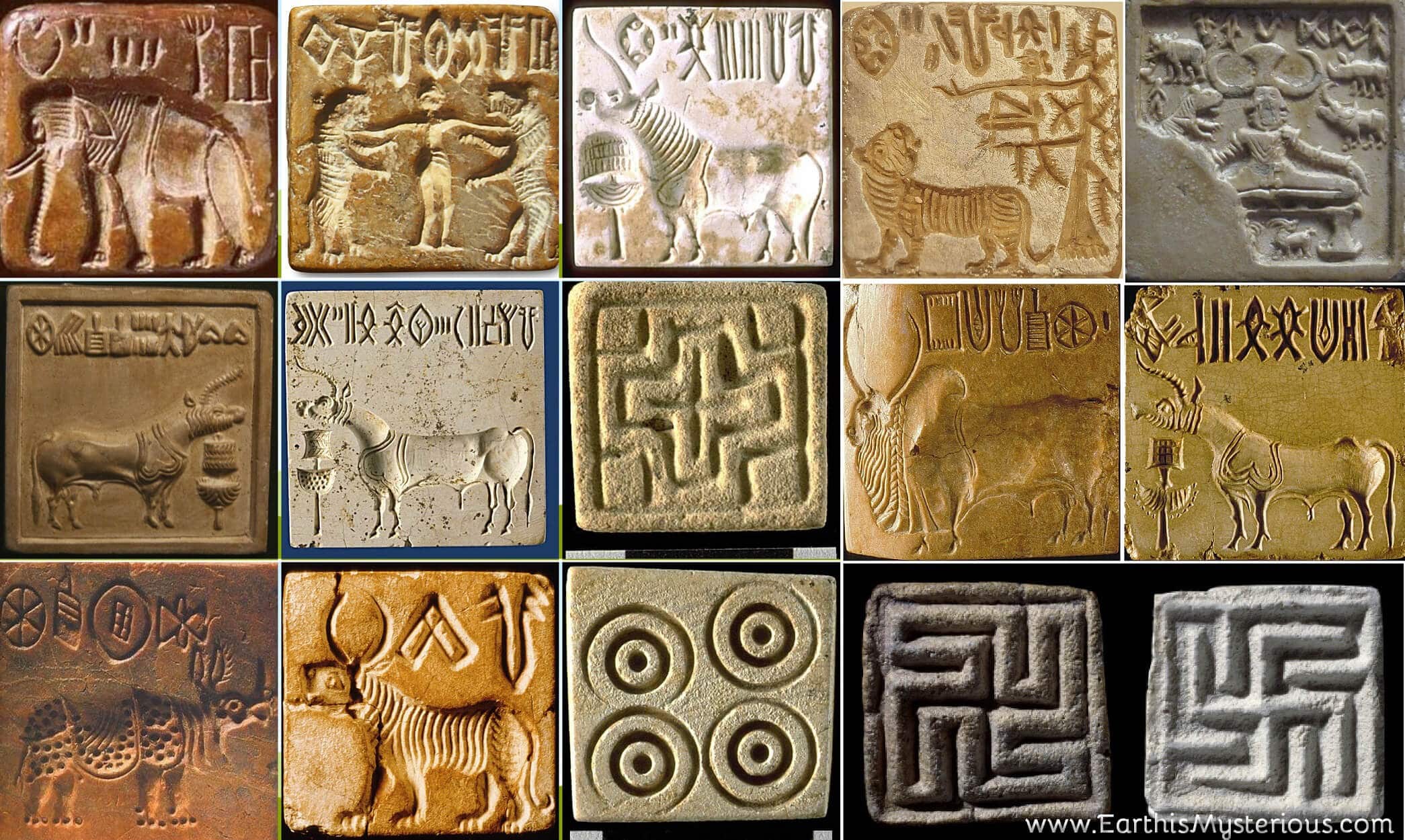
They later found more sites 400 miles south in Baluchistan and 500 miles east in Rakhigarhi in India. These were technologically advanced cities of their time, with sanitation, granaries, cotton fabric, mass-produced pottery, and a uniform system of weights and measures. The discovery of granaries and cotton fabric at the Indus Valley sites shows that farming technology was indigenous to the Indus Valley civilization. Furthermore, some seals found at these sites depict Yogic poses, and others are engraved with a Swastika (a symbol associated with Hinduism, Buddhism, and Jainism that indicates good health). Most recently in 2024, the Harappan script has been deciphered by an Hindu cryptographer to be an older version of Brahmi Script, and the language to be Sanskrit [paper].
The Aryan Invasion Theory (AIT) has since morphed into the Aryan Migration Theory (AMT), which changed the invasion to migration, but kept all the other bits. The non-genetic evidence presented for the AMT has been taken apart in pieces as technology has improved.
- Carbon dating of the excavations at the Rakhigarhi site in Rajasthan (India) set its date to 2600 BCE, well before the assumed Aryan migration in 1500 BCE.
- IVC artifacts were recovered in Gonur (Turkmenistan) and Shahr-i-Sokhta (Iran), but no Turkic or Iranian artifacts were found in the IVC sites.
- The artifacts at the site prove beyond doubt that the city had sanitation, granaries, cotton fabric, mass-produced pottery, and a uniform system of weights and measures. This proves that farming technology was developed well before the Aryans migrated.
- Seals found at these sites depict Yogic poses, and others are engraved with a Swastika, both signs of Vedic culture.
- The most popular seal in these sites depicts an animal that looks like a Unicorn (Horse + Horn) at the sacrificial altar.

That leaves us with the question of the R1a gene, and whether the Aryans migrated to India, or was it the other way around. A joint study between US and Indian scientists (Shinde et al) in 2019 looked at 60 genetic samples from Rakhigarhi (Indus Valley site), Gonur in Turkmenistan, and Shahr-i-Sokhta in Iran. The findings show that:
- The Iranian-related ancestry in the IVC derives from a lineage leading to early Iranian farmers, herders, and hunter-gatherers before their ancestors separated, contradicting the hypothesis that the shared ancestry between early Iranians and South Asians reflects a large-scale spread of western Iranian farmers east.
- 11 genetic samples in Iran and Turkmenistan belonged to first-generation migrants from the IVC; in other words, members of the IVC were moving into Iran and Turkmenistan (not the other way around). The genetic material of the Harappans living in Rakhigarhi had no Steppe DNA.
- The R1a1 gene has two to three times more mutations in Indian populations than in Europe, indicating that the R1a1 gene has been around in Indian populations a lot longer than in Europe. If the pastoralists mixed with the Indian population, it happened thousands of years prior to the mixing in Europe.
- The IVC is the common ancestor of all Indians. About 70% of the genetic material of North Indians comes from the IVC DNA, and 60% of South Indian genetic material has the IVC DNA.
It has been tricky to know the distant past due to the difficulty in obtaining DNA, but modern advancements in ancient DNA extraction have changed this. There is now DNA evidence refuting the idea of an “invasion”. A recent paper on Rakhigarhi DNA shows that the Harappan genome lacks ancestry from the supposed Aryan steppe pastoralists/Iranian farmers.
Final thoughts
The edifice of the Caste System has no legs to stand on in the subcontinent. I predict that with greater information-sharing and urbanization, the system of Jatis will also end within one generation. Before we discuss actionable steps, let us recap:
- Caste is a European colonial concept of racial profiling with the aim of segregation and controlling the flow of state resources to the “right” people.
- The Caste system is not a Hindu system or an Indian system. There is a lot of misinformation that assumes these equivalences due to prevailing colonial narratives, political reasons, ignorance, or malicious intent
- The conception of varṇa is not a caste system, and it was never birth-based
- Violence against Dalits is a real problem and a social evil in some parts of the world that we must address with the right policies. There is one known case (details, counterclaims of unconstitutionality) in the United States among many millions of US citizens and residents who come from the subcontinent.
How we can accelerate the end of Caste
- Teach your kids about Caste. Talk to your friends. Share this article.
- In parts of the world where this is a substantial problem, run community awareness programs and invite well-informed and unbiased speakers to your places of work to inform your friends and colleagues about the origin of Caste and current developments related to Caste
- Organize special events at work to break down barriers (viz., cooking classes, community meet and greets)
- (For those in the United States) The only available reliable study from Carnegie Endowment for Peace shows that caste discrimination is exceedingly rare in the US. If it occurs, we should apply existing policies. US citizens and legal residents should understand their rights and responsibilities under state and federal law.
How not to make it worse:
The Caste system is a racist construction born out of a colonial mind that should never have existed in the first place. As Hindus or people of Indic culture, we should uphold what the highest scripture and lived experience tells us – Our innate divinity unites all, that we are all part of one supreme consciousness, and we should treat every person with dignity and respect.
- We should not divide communities based on caste. We should aim for a caste-free society.
- We should not allow any religious phobia (hate for Hindus/Muslims) or race phobia (e.g., hate for Indians)
- We should not minimize the struggle that the members of the Dalit community have gone through in India and the subcontinent and the challenges they continue to face there. The subcontinent countries (India, Bangladesh, Pakistan) can and should bring about dignity and opportunity for all people regardless of background.
Citations
Beveridge, Annette Susannah 1842-1929. The Babur-Nama in English (Memoirs of Babur); Volume 2. BiblioBazaar, 2016
Guha, Sumit. Beyond Caste: Identity and Power in South Asia, Past and Present. Brill, 2013
Jha, Hetukar. Historical Sociology in India. Routledge, 2016
Martinez, Maria Elena. “Social Order in the Spanish New World.” Box 29 Folder 11. Hanna Holborn Gray Special Collections Research Center, University of Chicago Library, 2010. PBS.
Miller, Benjamin. “10 Facts About France’s ‘Untouchables.’” Listverse, 29 March 2018, https://listverse.com/2018/03/29/10-facts-about-frances-untouchables/
Prasad, Khandavalli Satya Deva. Interrogating Macaulay’s Children. Centre for Integral Research, Samvit Kendra, 2018.
Sharma, Jai. “The Portuguese Inquisition in Goa: A brief history.” IndiaFacts, 9 April 2015, https://indiafacts.org/the-portuguese-inquisition-in-goa-a-brief-history/
“Sumit Guha on Caste in South Asia.” YouTube, 31 January 2015, https://www.youtube.com/watch?v=MJfsEdzgvbw
“Writings and Speeches : Writings and.” Dr. BR Ambedkar, http://drambedkarwritings.gov.in/content/writings-and-speeches.php
Shinde, Vasant et al. “An Ancient Harappan Genome Lacks Ancestry from Steppe Pastoralists or Iranian Farmers.” Cell vol. 179,3